
A dieselpunk roguelite tactics game where squad positioning and mech matchups decide whether you liberate Europe or restart from scratch.
by: Milky Tea Studios
for: Consoles, Desktop
◆ Real-Time Tactics with Pause — Mechs auto-attack in range, but you manually reposition and trigger pilot abilities in live combat — pausing at any moment to think.
◆ Damage Triangle System — Fire beats Explosive, Explosive beats Ballistic, Ballistic beats Fire; matching counters is the primary skill layer throughout every run.
◆ Roguelite Campaign Structure — Each regional run strings together procedural missions with Slay the Spire–style branching paths, mid-run boosters, and run-ending permadeath.
◆ Dual Progression Layer — Per-run mech augments provide temporary boosts; Scrap, Valor, and Blueprints earned persist across deaths to permanently unlock mechs and pilot skills.
◆ VR Support (Post-Launch) — A full August 2025 VR port for PlayStation VR2, SteamVR, and Quest adds a tactile commanding perspective unavailable in competing tactics titles.

Developer:
Milky Tea Studios
Publisher:
Megabit
Genre:
Real-time Tactics / Rougelite
Release:
PC: March 26, 2025 | Console: August 21, 2025
Grit and Valor – 1949 is a dieselpunk real-time tactics roguelite developed by Milky Tea Studios and published by Megabit Publishing, set in an alternate-history 1949 where the Axis powers — led by a mad scientist called Doctor Z — have conquered Europe using giant mechs. You command a small squad of captured Axis mechs for the Resistance, fighting country by country toward Machine Tower, the enemy’s oil-refinery headquarters. If you want turn-based puzzle precision or the large-scale army management of a traditional RTS, this is the wrong game — Grit and Valor is deliberately compact, fast, and structured around repeated failure and incremental progress.
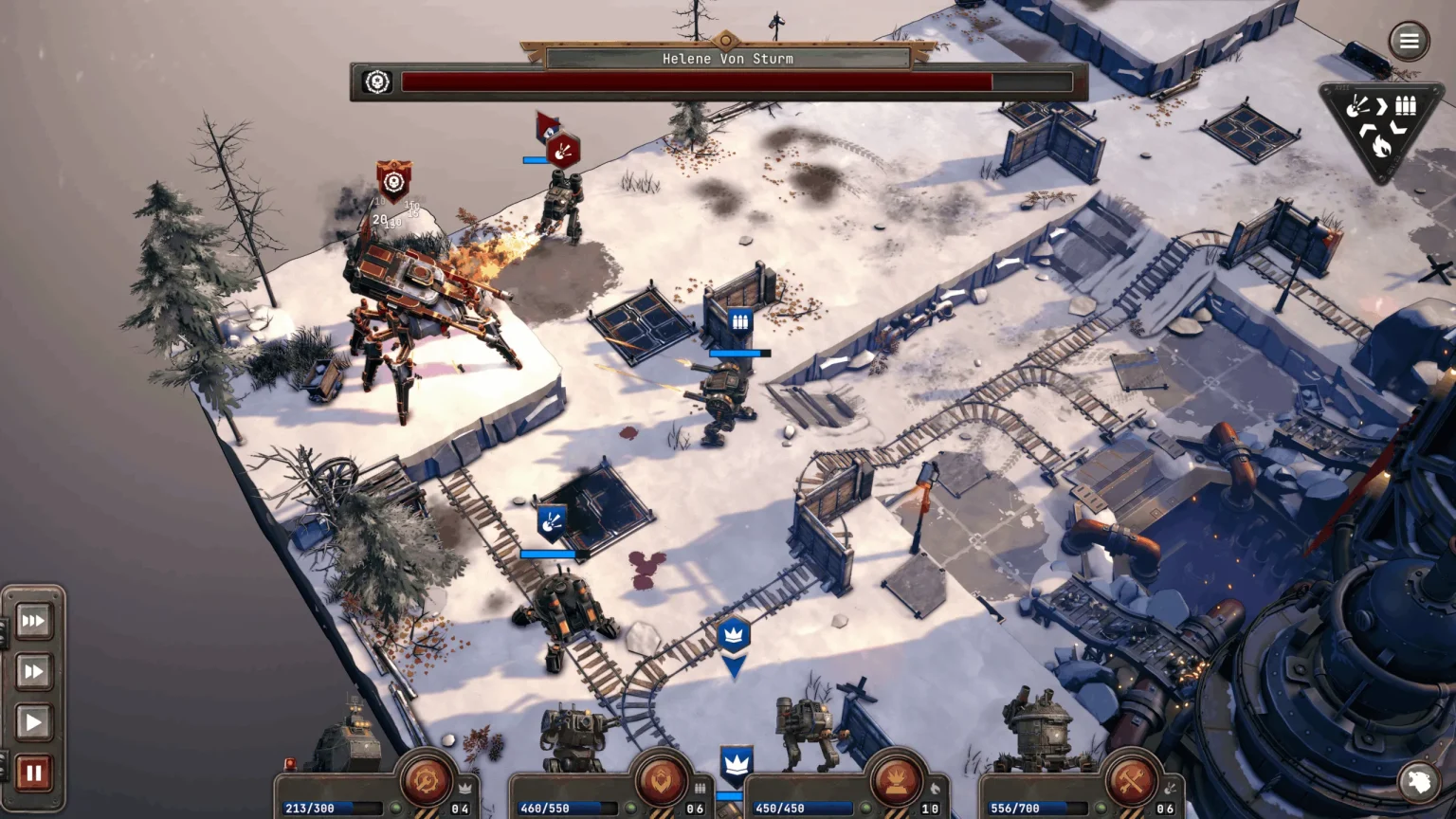
The first hour is a beauty with teeth. The tutorial drops you onto a miniature rotatable diorama of the British Isles — cobblestone rubble, industrial pipes, height-advantage ramps — and walks you through the damage triangle with clarity. Then the first real campaign mission opens, three mech types arrive from random entry points, and you realise that the mechs won’t fire while moving. That single mechanic — attack or move, never both — is the game’s central tension, and it punishes you visibly and repeatedly until you internalise it. Expect your first two or three runs to end well before reaching France.
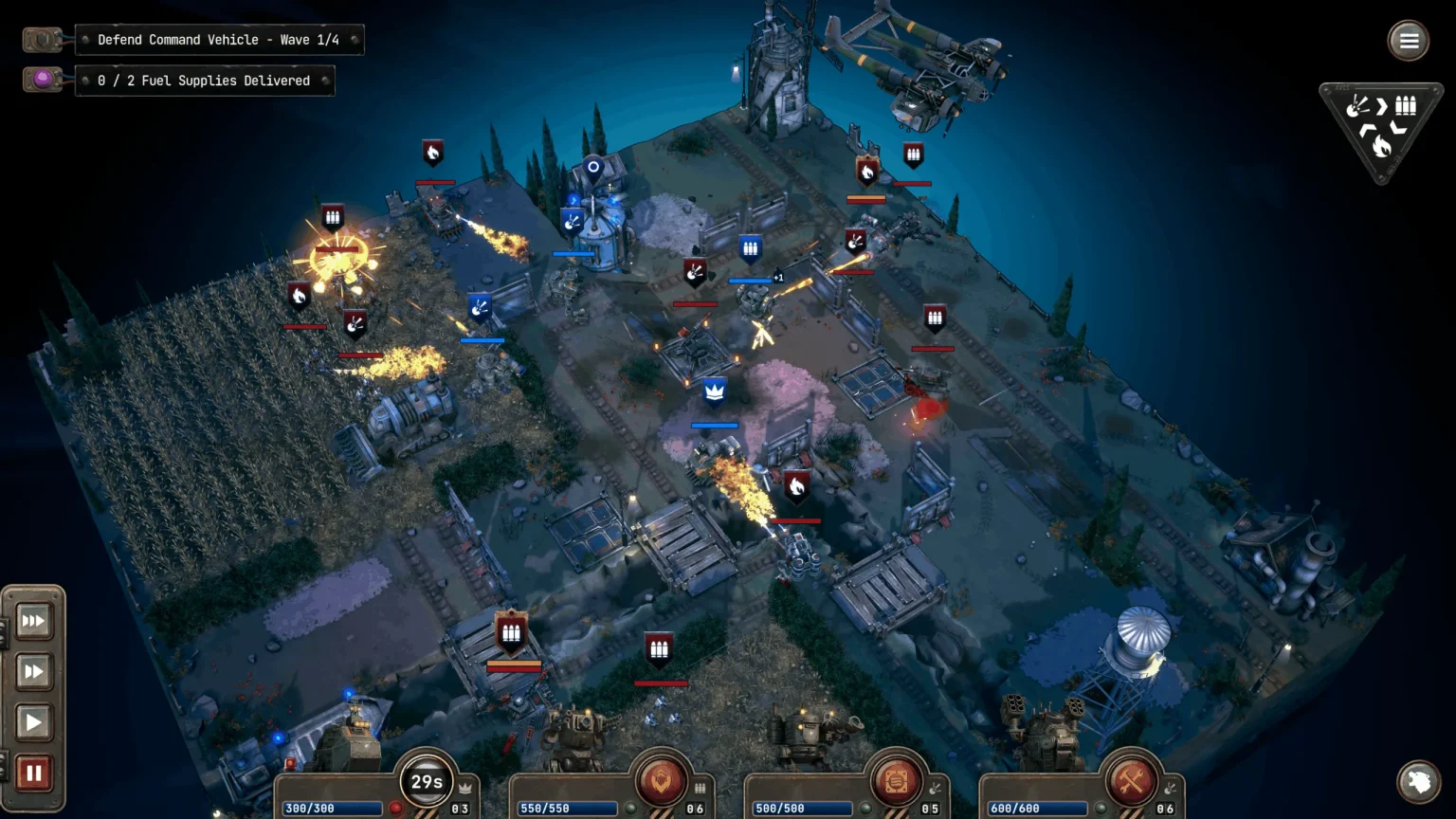
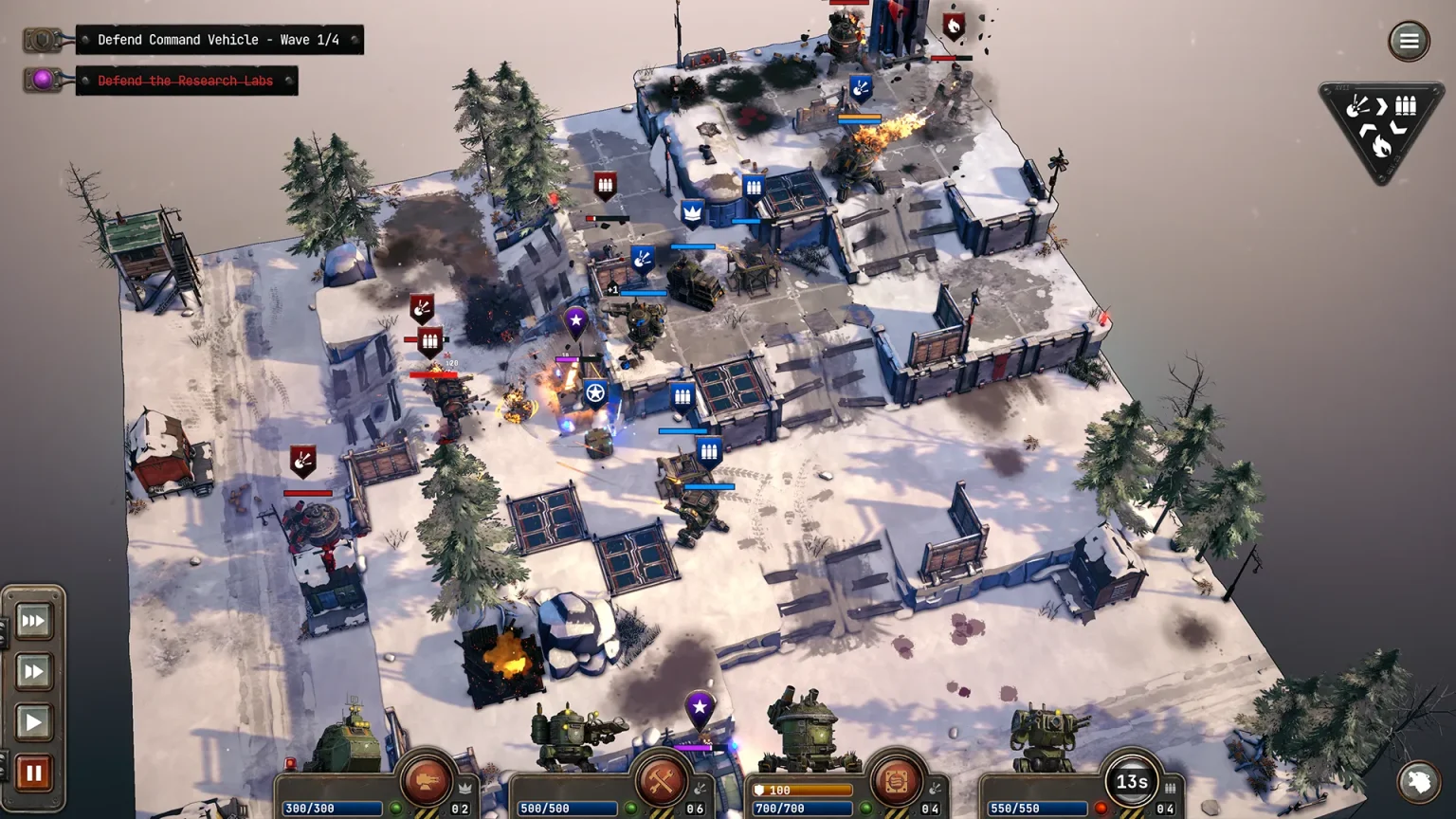
The Grit and Valor strategy loop revolves around three interlocking systems: positioning, matchups, and the command vehicle. Every wave tells you from which side enemies are approaching, giving you a narrow window to reposition mechs to face the right counters. Fire types are strong against Explosive mechs, Explosive beats Ballistic, Ballistic beats Fire — the damage triangle is shown via icons in the top-right corner during combat and must be the first thing you check every engagement. Protecting the command vehicle is the run’s primary survival objective: it cannot attack, moves slowly, and losing it ends your run instantly even with mechs still standing. The best approach to keeping the command vehicle alive is to never let it stray beyond your mechs’ defensive perimeter, use it to collect crates only when an adjacent mech is stationary and able to cover approach routes, and sacrifice it for objectives only if the resource gain triggers a Valor upgrade that permanently improves the next run. Between missions, a Slay the Spire–style path lets you choose between Combat maps (loot), Advanced Combat (higher rarity upgrades), and Salvage Shops (buy with Black Coins). Prioritising Advanced Combat early is the consensus best Grit and Valor strategy for building a high-rarity mech augment before the mid-campaign difficulty spike.
The best mech builds in Grit and Valor reward focus over spread. Concentrating all augments onto a single high-range mech — typically a Ballistic or Fire type depending on your run’s enemy spread — and then pairing it with a tank pilot who can absorb damage for the run produces more reliable results than distributing mediocre upgrades across three mechs. The Thunderhead mech in particular becomes one of the most powerful units in the game when upgraded with the Infinite Mines module and a Damage Resistance perk triggered by its ability, turning it into an effective front-line anchor that draws enemy priority while your command vehicle completes secondary objectives safely.
The alternate history premise is more developed than the genre norm. Each character — from Resistance commanders to enemy faction leaders — is hand-drawn with distinct visual personality, and the dialogue is punchy and contextually aware of the alt-WWII setting without overstaying its welcome. Doctor Z functions as a cartoonish-but-effective villain, and the region-by-region liberation structure (British Isles → France → Germany → New Germany) gives the campaign a satisfying geographic sense of progress that many roguelites deliberately avoid. It’s not Disco Elysium, but for a tactics game, the lore does genuine work.
The diorama art direction is the game’s strongest visual asset and the clearest differentiator from competition. Each battlefield is a rotatable miniature — rubble-strewn European streets, industrial refinery sectors, windswept island terrain — that reads cleanly from any angle and makes terrain height and line-of-sight obstacles legible without clutter. Mech designs are chunky, purposeful, and type-readable at a glance. Audio is well-matched to the aesthetic: weapon-type impacts are distinct (the ballistic clatter is clearly different from the flamethrower whoosh), and the voiced commanding officer adds immersion that text-only games in the genre lack. Performance is stable on PC and Steam Deck with no documented widespread bugs at the current patch.
Grit and Valor – 1949 is a $19.99 flat-price purchase with no in-app purchases, no battle pass, and no announced DLC. The VR port (PS VR2, SteamVR, Quest) released in August 2025 is a separate purchase developed by nDreams, not a paid upgrade for existing owners. At the base price, $19.99 represents strong value for a roguelite with 20–40 hours of mechanical depth and an active balance patch history.
The pause function is Grit and Valor’s most significant accessibility concession and it matters: you can freeze combat entirely at any moment to scan the board, issue movement orders, and plan your next three actions. There is no dedicated difficulty setting, however, and the early-game reward thinness means the game’s effective difficulty is not adjustable for players who don’t want to grind failed runs for meta-currency. No colourblind modes are documented, which is a gap given that the damage triangle system relies entirely on colour-coded type icons.
No multiplayer exists and the design clearly never intended it — the command vehicle protection mechanic and real-time positioning loop are designed as a single-player cognitive puzzle. The Steam community is active with strategy discussion threads, single-mech concentration guides, and meta-progression breakdowns. The game runs well on Steam Deck, which has extended its community footprint beyond desktop audiences.
Against Into the Breach, Grit and Valor – 1949 wins on pace and immediacy — real-time combat with pause creates urgency and visceral feedback that turn-based grids can’t replicate — but loses on puzzle elegance, as Into the Breach’s perfectly legible information-complete turn structure means every failure is clearly your own mistake, whereas Grit and Valor occasionally punishes you with early-wave entry patterns that feel unfair before meta-progression compensates.
Against Iron Harvest, Grit and Valor wins on accessibility and session length — its compact diorama battles complete in under an hour and demand no army-management infrastructure — but loses on scale and spectacle, since Iron Harvest’s large-scale diesel-punk battles with multiple unit types, base construction, and cinematic campaign delivery simply have more visual and strategic surface area.
Damage triangle system is immediately learnable, endlessly deployable
Pause-anywhere real-time combat hits a genuine sweet spot
Dieselpunk diorama visuals are genuinely distinctive
Meta-progression is motivating across deaths
Early game punishes before progression compensates
Mid-run upgrade variety narrows too quickly
Attack-or-move restriction creates unavoidable punishment windows
A dieselpunk roguelite tactics game where squad positioning and mech matchups decide whether you liberate Europe or restart from scratch.
by: Milky Tea Studios
All files are original, sourced from official developer.
The download will start from the developer’s website.
AnySoftware does not host, repack or modify download files in any way.
Powered by
A dieselpunk roguelite tactics game where squad positioning and mech matchups decide whether you liberate Europe or restart from scratch.
by: Milky Tea Studios
All files are original, sourced from official developer.
The download will start from the developer’s website.
AnySoftware does not host, repack or modify download files in any way.
Powered by
A dieselpunk roguelite tactics game where squad positioning and mech matchups decide whether you liberate Europe or restart from scratch.
by: Milky Tea Studios
All files are original, sourced from official developer.
The download will start from the developer’s website.
AnySoftware does not host, repack or modify download files in any way.
Powered by