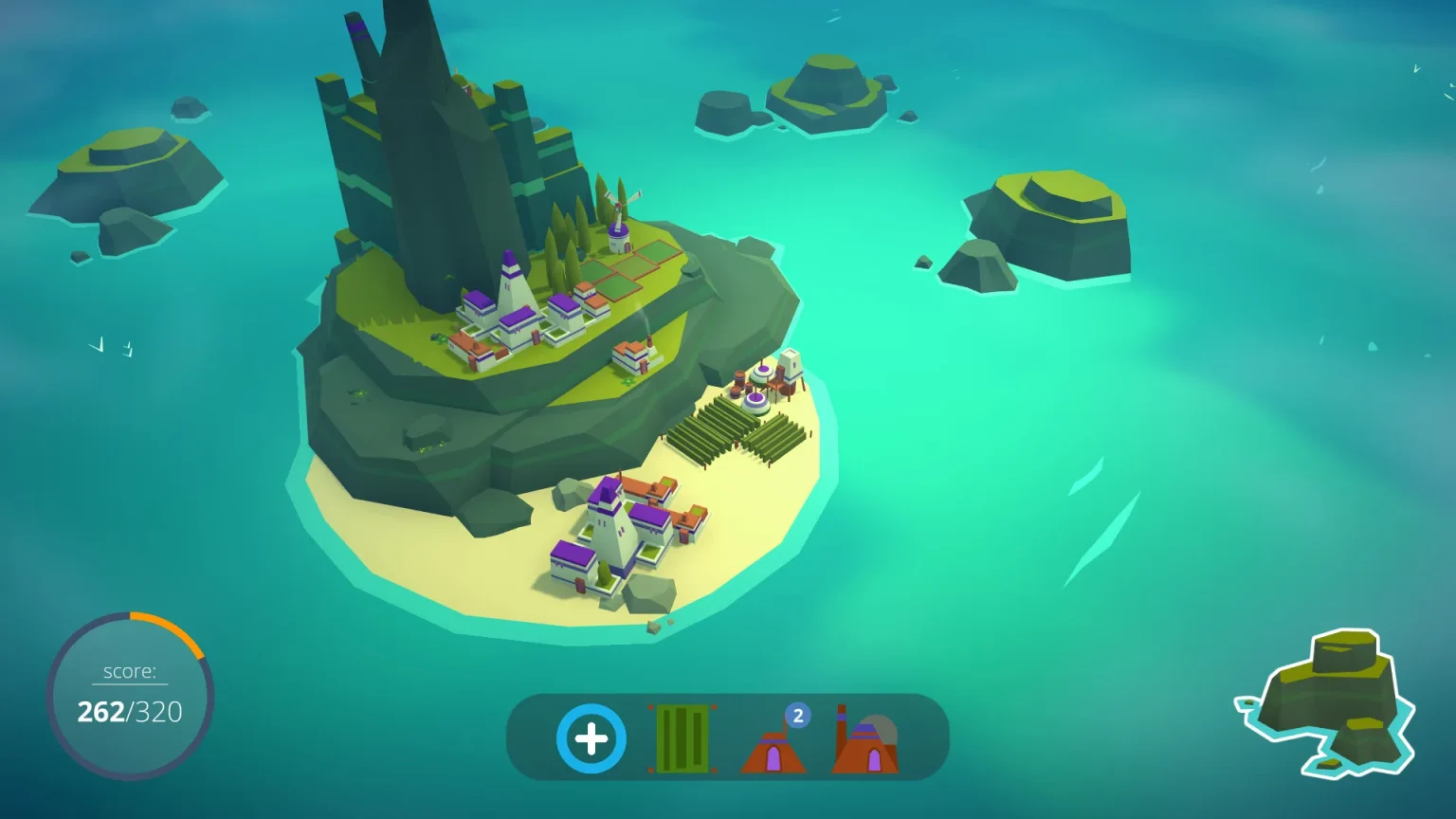
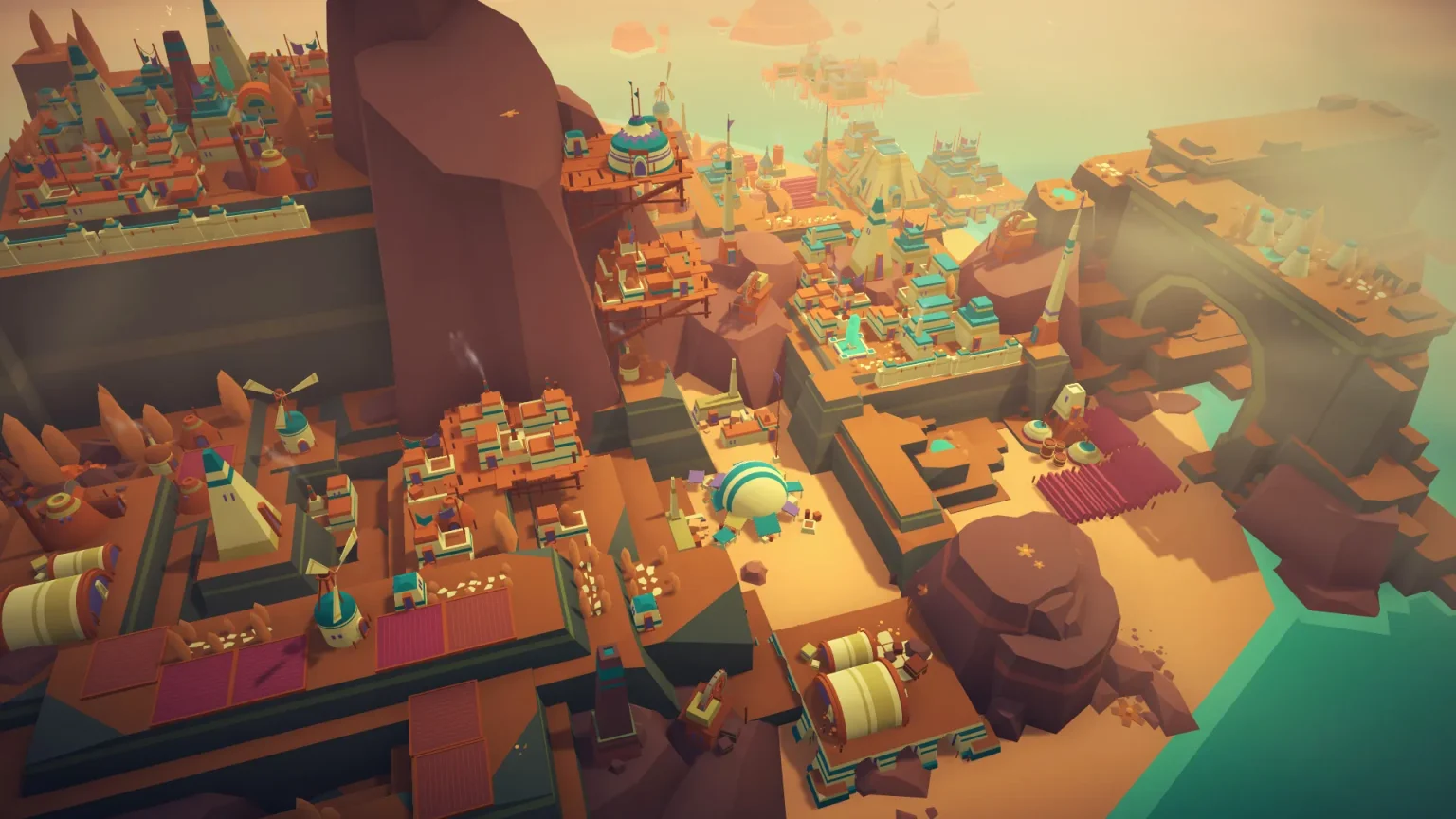
WHAT IS ISLANDERS?
Islanders is a minimalist puzzle city-builder developed by GrizzlyGames and published by Coatsink, originally released in 2019 for PC and later ported to consoles. Its sequel, Islanders: New Shores, arrived July 10, 2025, developed by Swedish studio The Station with the same publisher. Both games place you on a procedurally generated island and ask you to score points by positioning buildings next to compatible neighbors — a fishery next to water, a mansion next to a market, a temple on an elevated plateau. If you need narrative drive, currency management, population satisfaction meters, or anything resembling a traditional city-builder’s complexity, neither game will hold you for long.
FIRST IMPRESSIONS
The opening moments are disarmingly quiet. A small island appears — pastel green hills, a shimmer of blue water — and your first building pack drops into your hand. You place a handful of houses, a field, a mill, and the numbers tick up pleasantly. There is no tutorial beyond a tooltip explaining that green means points gained and red means points lost, and you don’t need one. Within ten minutes, you’re already making decisions with long-term implications — should the city center go near the coast now, or leave that space for the temple that might appear in three rounds? The hook is the gap between how calm the game looks and how carefully you’re actually thinking.
GAMEPLAY & MECHANICS
The entire Islanders strategy loop runs through a single currency: points. Every building scores or loses points based on proximity rules — city centers penalize each other heavily, lighthouses need unobstructed sightlines, shamans prefer tight crevices with no view. Score enough points on a current island and you unlock the ability to advance to a new one; fall short and your run ends. The best Islanders strategy is to mentally zone your island before placing anything — designate a housing cluster, an industrial strip, and a reserved space for large late-game structures like temples and markets. In New Shores, the boon system changes the calculus significantly. Boons unlock as you accumulate points and function as one-time interventions: the “Neighborly” boon removes inter-building penalties, others shrink building footprints to fit impossibly tight terrain, and one duplicates your current building pack to extend a productive placement streak. The post-launch challenge modes — A Short Journey (three-island limit), No Time to Dillydally (30-minute timer), and Temple Trouble (temple-score leaderboard) — add meaningful variety that the base game at launch slightly lacked.
STORY & WORLD
There is no story in either game. The world-building exists entirely through visual atmosphere — the volcanic island where your settlement improbably sits on lava platforms, the arctic biome where snow accumulates on rooftops, the tropical shores with fish eddies visible in the water. New Shores’ day/night cycle and weather system do more narrative work than any text could: watching your island’s windows flicker on as dusk falls and rain sweep across your markets creates a sense of a living place that the original’s static lighting never achieved. For a game with no characters or dialogue, that’s quietly impressive.
VISUALS, AUDIO & PERFORMANCE
New Shores retains the low-poly, block-color minimalism that made the original distinctive but sharpens it considerably. Building models are less cubic and more architectural, the terrain has real topographic texture, and the water responds visually to both fish shoals and weather. The photo mode — with filters including Postcard, Old Film, Sepia, and Halftone — is a genuine addition for players who treat their islands as creative canvases rather than point puzzles. Performance is rock-solid across all platforms at the current patch; no frame-drop complaints appear in the community at scale. The 75-minute original soundtrack is the game’s secret weapon: ambient, unhurried, and precisely suited to the cognitive state of quiet spatial reasoning the game asks of you.
MONETISATION & VALUE
Both games are flat-price purchases with zero ongoing monetization. You pay $4.99 for the original or $9.99 for New Shores and own everything — no battle pass, no premium currency, no paid DLC. Post-launch challenge modes were added to New Shores as a free update. In a genre landscape where even small mobile puzzle games routinely gate content behind $9.99 weekly bundles, this is genuinely refreshing. The $9.99 price point for New Shores is the correct ask for what you receive.
ACCESSIBILITY
Islanders’ single-input placement system is inherently accessible to most players — the game requires only pointing, clicking or tapping, and basic color-reading for the score indicators. However, no documented colorblind modes exist in either title, which is a problem given that the scoring feedback system is entirely color-coded (green versus red overlays). No difficulty settings exist by design, as the game’s procedural nature handles variation organically. New Shores’ addition of challenge modes does offer implicit difficulty scaling, but formal accessibility options remain thin.
MULTIPLAYER & COMMUNITY
Neither game includes multiplayer, and that’s not a flaw — the score-chasing loop is a deeply personal spatial puzzle that doesn’t benefit from real-time competition. New Shores does include Twitch integration allowing viewers to vote on building pack selection, which is a smart feature for streamers and transforms the experience into a collaborative one without requiring infrastructure. The player community is active across Steam guides, Reddit, and Fandom wikis, producing well-documented strategy threads and high-score breakdowns that give dedicated players a meaningful extended learning curve.
HOW IT COMPARES
Against Dorfromantik, Islanders: New Shores wins on strategic depth — the building synergy system and boon mechanics demand more analytical thinking than Dorfromantik’s tile-matching loop — but loses on tactile satisfaction, as placing a hexagonal tile against a perfectly matching landscape edge in Dorfromantik delivers a moment of sensory click that Islanders’ point-hunting late game never quite matches.
Against Townscaper, Islanders wins decisively on having an actual game to play — Townscaper is a creative toy with no score, no failure state, and no progression, which its own developer freely acknowledges — but loses on pure creative freedom, as Townscaper imposes no placement rules and lets you build anything, anywhere, in any colour, with zero consequence.